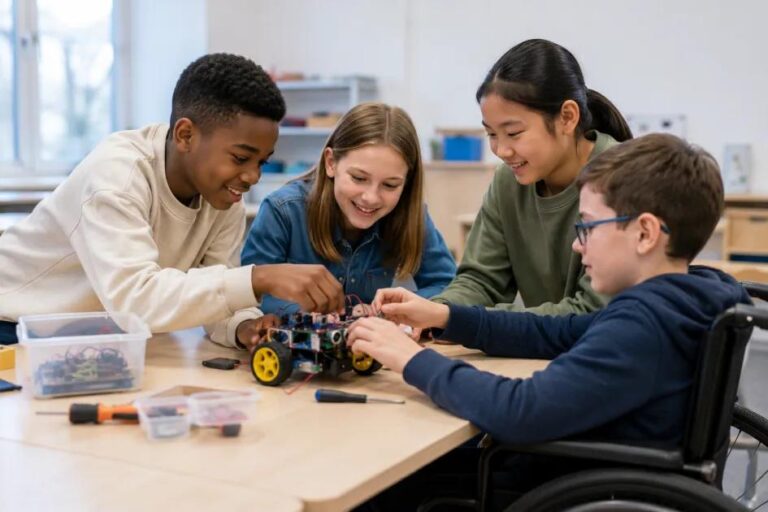

What Does a Mechanical Engineer Do? A Kid-Friendly Career Guide
Have you ever wondered how roller coasters move, how cars are designed, or how machines help doctors save lives?
Behind many of these inventions are mechanical engineers.
If your child enjoys building things, solving puzzles, or figuring out how objects work, learning what a mechanical engineer does could introduce them to an exciting STEM career.
Mechanical engineering is one of the broadest fields of engineering. Mechanical engineers help design, develop, test, and improve machines and mechanical systems that people use every day.
And here’s something children might find surprising: mechanical engineers don’t just work on cars or engines. They can help create medical devices, spacecraft components, renewable energy systems, robots, and even equipment used to manufacture food.
Let’s explore what mechanical engineers do, where they work, and how kids can begin developing engineering skills today.
What Is Mechanical Engineering?
Mechanical engineering is a branch of engineering focused on how objects move, how forces affect materials, and how energy is used to make systems work.
Mechanical engineers apply science, mathematics, creativity, and problem-solving to design and improve products and equipment.
Think about a bicycle.
Someone must consider how the wheels rotate, how the brakes stop the bicycle, how the frame supports a rider, and how the gears help make pedaling easier.
Mechanical engineering principles play a role in all these features.
The same ideas can apply to much larger systems, including trains, manufacturing equipment, wind turbines, and power plants.
In simple terms, mechanical engineers figure out how things work and how to make them work better.
What Does a Mechanical Engineer Do Every Day?
Mechanical engineers perform different tasks depending on their jobs and the industries where they work.
Some spend time designing equipment using computer software. Others test products, visit industrial facilities, review technical calculations, or work with teams to solve complex problems.
Here are five common responsibilities.
1. Design Machines and Equipment
Mechanical engineers develop ideas for new machines, products, and mechanical components.
They may use computer-aided design software, commonly called CAD, to create detailed models and drawings.
For example, an engineer designing a bicycle might study the frame, gears, and braking system to make sure the bicycle performs safely and efficiently.
2. Solve Real-World Problems
Engineering begins with identifying a problem.
Imagine a factory machine that keeps overheating. A mechanical engineer might investigate the cause, review how the equipment operates, and recommend changes to improve performance.
Engineers often work through several possible solutions before selecting the best approach.
3. Test and Improve Designs
Before a product or machine is used, engineers may conduct tests to evaluate how well it performs.
They might measure temperature, pressure, movement, vibration, or strength.
When something doesn’t work as expected, they use the results to improve the design.
This process is an important part of engineering: design, test, learn, and improve.
4. Use Mathematics and Science
Mechanical engineers use mathematics and scientific principles to understand how machines and systems behave.
They may calculate how much weight a structure can support, how much energy a machine requires, or how fluids move through pipes.
Children don’t need to know advanced mathematics to begin exploring engineering. Building, measuring, and comparing results are great starting points.
5. Work With Other Professionals
Mechanical engineers rarely work alone.
They collaborate with electrical engineers, software developers, scientists, technicians, project managers, and other specialists.
Communication and teamwork are just as important as technical knowledge.
Where Do Mechanical Engineers Work?
One of the most exciting things about mechanical engineering is the variety of industries where engineers can build careers.
Automotive and Transportation
Mechanical engineers help develop vehicles, engines, braking systems, and other transportation technologies.
They may work on traditional vehicles, electric vehicles, trains, or equipment used in transportation systems.
Aerospace and Space Exploration
Mechanical engineers contribute to aircraft, spacecraft, satellites, and related equipment.
They may design mechanical components, analyze materials, or test systems that must operate under challenging conditions.
Healthcare and Medical Technology
Mechanical engineers help develop medical devices, prosthetic components, surgical equipment, and other healthcare technologies.
Their work can improve how medical professionals diagnose, treat, and care for patients.
Energy and Power Generation
Mechanical engineers work with equipment used to produce and distribute energy.
They may help design or maintain turbines, pumps, valves, piping systems, and other mechanical equipment.
This includes opportunities in renewable energy, conventional power generation, and nuclear energy.
Robotics and Manufacturing
Factories use machines and automated systems to produce everything from food packaging to automobile parts.
Mechanical engineers help design, improve, and maintain equipment that supports these processes.
Consumer Products
Mechanical engineers can also work on products people use at home, such as appliances, tools, exercise equipment, and other mechanical devices.
Everyday products often require careful engineering to make them useful, reliable, and safe.
What Skills Do Mechanical Engineers Need?
Mechanical engineering combines technical knowledge with practical skills that children can begin developing early.
Problem-Solving
Engineers investigate challenges and develop solutions.
Encourage children to ask, “What problem am I trying to solve?” before beginning a project.
Creativity
Engineering requires imagination.
Before a new product exists, someone must imagine how it could work.
Children who enjoy drawing, building, or inventing can use those interests to explore engineering.
Mathematics
Engineers use mathematics to measure, calculate, and analyze.
For younger children, practicing measurement, shapes, patterns, and basic calculations builds a useful foundation.
Science
Mechanical engineering draws on physics and other scientific concepts.
Children can explore forces, motion, energy, heat, and materials through simple experiments.
Communication and Teamwork
Engineers explain ideas, document results, and work with other people.
Group projects help children practice listening, sharing responsibilities, and discussing different solutions.
Persistence
Not every design works the first time.
Successful engineers learn from unexpected results and make improvements.
Helping children understand that mistakes are part of learning can build confidence.
How Do Kids Become Mechanical Engineers?
Children don’t need to begin planning college courses in elementary school. They can start by developing curiosity and enjoying hands-on activities.
As students progress through school, they can explore mathematics, science, computer technology, and engineering-related electives.
Elementary School
Focus on exploration.
Children can build structures, experiment with simple machines, and learn how everyday objects work.
Useful activities include LEGO projects, paper airplanes, model bridges, and balloon-powered cars.
Middle School
Students can begin exploring more challenging design projects.
Robotics clubs, coding activities, science fairs, and engineering competitions offer opportunities to apply new skills.
High School
Students interested in engineering can explore courses in mathematics, physics, computer science, and engineering design.
They may also participate in internships, summer programs, technical education pathways, or engineering clubs.
College and Career Preparation
Many mechanical engineering positions require a bachelor’s degree in mechanical engineering or a closely related field.
Students typically study subjects such as mechanics, thermodynamics, materials, fluid mechanics, mathematics, and engineering design.
Some engineering careers may also involve professional licensure, additional training, or advanced degrees.
Families can explore occupational information through the U.S. Bureau of Labor Statistics Occupational Outlook Handbook.
Three Fun Mechanical Engineering Activities for Kids
The best way to understand engineering is to try it.
Here are three simple activities that help children explore mechanical engineering concepts.
Activity 1: Build a Balloon-Powered Car
What you’ll need:
- Cardboard
- Four bottle caps or lightweight wheels
- Two straws
- Two wooden skewers
- A balloon
- Tape
- Scissors
- Adult supervision
Instructions:
- Cut a rectangular piece of cardboard to create the car’s body.
- Attach two short straws underneath the cardboard as axle guides.
- Slide wooden skewers through the straws.
- Attach wheels to the ends of the skewers.
- Secure a balloon to another straw and attach it to the car.
- Inflate the balloon, pinch the opening, place the car on a smooth surface, and release.
Engineering challenge: Change the wheel size or car weight and compare how far the car travels.
What kids learn: Forces, motion, friction, and the engineering design process.
Activity 2: Create a Paper Bridge
What you’ll need:
- Several sheets of paper
- Two stacks of books
- Small coins
- Tape, if needed
Instructions:
- Place two stacks of books a short distance apart.
- Lay a flat sheet of paper across the gap.
- Add coins carefully and observe how much weight the paper supports.
- Fold another sheet into an accordion shape.
- Test the folded bridge and compare the results.
Engineering challenge: Determine which paper design supports the most weight.
What kids learn: Structural strength, forces, and design improvement.
Activity 3: Design a Paper Helicopter
What you’ll need:
- Paper
- Scissors
- Paper clips
- A ruler
Instructions:
- Cut a paper strip and create two rotor blades at the top.
- Fold the blades in opposite directions.
- Add a paper clip to the bottom for weight.
- Drop the helicopter from a safe height.
- Observe how it spins as it falls.
Engineering challenge: Change the blade length or paper clip weight and compare the results.
What kids learn: Air resistance, gravity, and motion.
These activities are designed to encourage experimentation. Adult supervision is recommended when children use scissors, skewers, or other tools.
Common Questions Kids Ask About Mechanical Engineering
Do mechanical engineers build robots?
Yes, some mechanical engineers help design and develop robots. They may work on moving parts, mechanical structures, motors, and other components.
Robotics also involves electrical engineering, software development, and other disciplines.
Do mechanical engineers have to be good at math?
Mathematics is an important part of mechanical engineering, but children can build their skills over time.
Hands-on projects can help students understand why measurement, geometry, and calculations matter.
Is mechanical engineering only about fixing machines?
No. Mechanical engineers often design, analyze, test, and improve equipment and systems.
Repairing and maintaining machinery may be part of some jobs, but mechanical engineering includes many other responsibilities.
Can girls become mechanical engineers?
Absolutely. Mechanical engineering is a career opportunity for anyone interested in designing solutions and understanding how things work.
Children benefit from seeing engineers from many different backgrounds.
What school subjects are important for mechanical engineering?
Mathematics, science, physics, computer technology, and engineering design are especially useful.
Communication, creativity, and teamwork are also important.
Why Mechanical Engineering Is an Exciting STEM Career
Mechanical engineering offers opportunities to work on problems that affect everyday life.
An engineer might help improve medical equipment, develop cleaner energy systems, design transportation technologies, or create machines that make manufacturing more efficient.
Some engineers work in offices. Others visit laboratories, factories, construction sites, or power facilities.
The work can involve designing new technologies, improving existing systems, and collaborating with teams to solve challenges.
For children who enjoy discovering how things work, mechanical engineering can open the door to many possibilities.
Final Thoughts: Inspire the Next Generation of Mechanical Engineers
You never know where a child’s curiosity might lead.
A simple paper airplane could spark an interest in aerodynamics. A toy car might inspire questions about motion and energy. A homemade bridge could introduce the principles of engineering design.
Helping children explore mechanical engineering doesn’t require expensive equipment or advanced technical knowledge.
It starts with curiosity, encouragement, and opportunities to experiment.
The next time your child asks, “How does that work?” consider exploring the answer together.
That question could be the beginning of an exciting STEM journey.
Continue Exploring STEM Careers With STEM Crew Magazine!
Discover inspiring STEM professionals, educational resources, and hands-on activities that help children explore the possibilities of science, technology, engineering, and mathematics.
Read your free digital issue at www.stemcrewmagazine.com.
Explore. Discover. Inspire. The next generation of STEM leaders starts here.