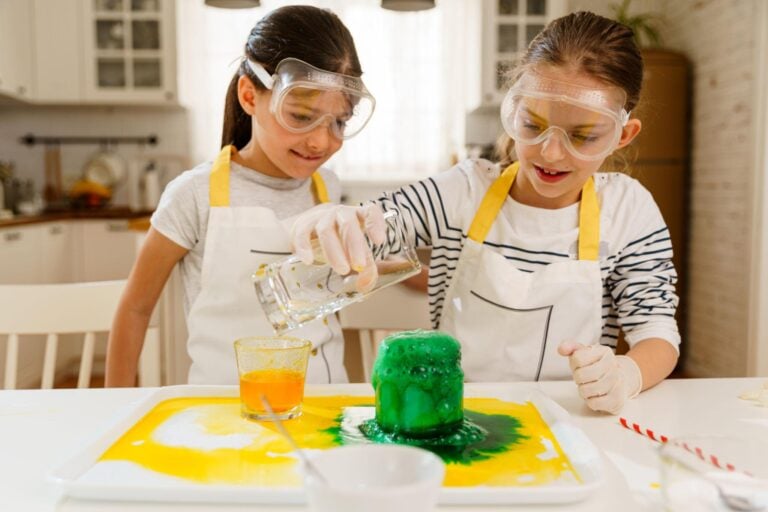

8 Fun STEM Experiments Families Can Try on the Weekend
Looking for something fun and educational to do with your kids this weekend?
You don’t need to visit a science museum, purchase an expensive experiment kit, or turn your kitchen into a laboratory.
Some of the most memorable learning experiences begin with everyday household materials and a simple question: What do you think will happen?
These fun STEM experiments for kids at home help families explore science, technology, engineering, and mathematics through hands-on activities that encourage curiosity, creativity, and problem-solving.
From creating a colorful walking-water experiment to building a homemade catapult, each activity offers opportunities to investigate how the world works.
Whether you’re planning a Saturday morning project, a rainy-day activity, or an educational family night, these eight experiments can make STEM learning part of your weekend routine.
Why Weekend STEM Experiments Are Great for Families
Weekends can provide opportunities for children to explore interests beyond their regular school assignments.
STEM experiments allow families to spend time together while practicing important learning skills.
Children can ask questions, make predictions, observe results, and explain what they’ve discovered.
Parents and caregivers don’t need to know every scientific answer.
In fact, exploring unfamiliar questions together can help children see that learning is a lifelong process.
Weekend STEM activities can encourage:
- Curiosity and scientific observation.
- Problem-solving and critical thinking.
- Creativity and experimentation.
- Communication and teamwork.
- Mathematical measurement and comparison.
- Confidence when trying something new.
The goal isn’t to complete every activity perfectly.
It’s to enjoy discovering something together.
Before You Begin: Create a Simple STEM Experiment Station
You can prepare for a weekend of STEM exploration using materials already available around the house.
Helpful Household Supplies
Gather items such as:
- Clear plastic cups.
- Paper towels.
- Water.
- Food coloring.
- Paper and cardboard.
- Tape and string.
- Rulers and measuring cups.
- Balloons.
- Plastic spoons.
- Craft sticks.
- Baking soda and vinegar.
- Pencils and notebooks.
Not every activity requires all these materials.
Choose one or two experiments based on your children’s interests and the time available.
Keep Safety in Mind
Adult supervision is important, especially when activities involve scissors, small objects, balloons, or household ingredients.
Use food-safe or child-appropriate materials where possible.
Never mix household cleaning products or substitute unfamiliar chemicals into experiments.
Children should avoid tasting experimental materials, and everyone should wash their hands after activities.
For younger children, select experiments without choking hazards.
Experiment 1: Make a Rainbow With Walking Water
Best for: Ages 5–10
Time: 10–15 minutes to set up; several hours for observation.
STEM focus: Capillary action, water movement, and color mixing.
Materials Needed
- Seven clear cups.
- Water.
- Red, yellow, and blue food coloring.
- Six paper towel strips.
Step-by-Step Instructions
- Arrange the seven cups in a row.
- Fill cups 1, 3, 5, and 7 about halfway with water.
- Add red food coloring to cups 1 and 7, yellow to cup 3, and blue to cup 5.
- Leave cups 2, 4, and 6 empty.
- Fold paper towel strips lengthwise.
- Place one end of each strip into one cup and the other end into the neighboring cup.
- Observe the water moving through the paper towels over time.
As the colored water moves into the empty cups, colors may begin mixing.
What’s the Science?
Paper towels contain tiny spaces between fibers.
Water can move through these spaces through capillary action, which involves adhesion, cohesion, and surface tension.
This movement allows water to travel through the paper towel and into neighboring cups.
Family STEM Challenge
Try different brands of paper towels.
Which moves water more quickly?
Change only one factor at a time and compare the results.
Experiment 2: Build a Balloon-Powered Rocket
Best for: Ages 6–12
Time: 15–25 minutes.
STEM focus: Forces, motion, and Newton’s Third Law.
Materials Needed
- Balloon.
- Long piece of string.
- Drinking straw.
- Tape.
- Two secure attachment points.
Step-by-Step Instructions
- Thread the string through the straw.
- Stretch the string tightly between two secure points.
- Inflate the balloon without tying it.
- Hold the balloon opening closed.
- Tape the balloon to the straw, keeping the opening pointed toward one end of the string.
- Move the balloon to the starting point.
- Release the opening and watch the balloon travel along the string.
What’s the Science?
As air rushes out of the balloon, the balloon experiences a force in the opposite direction.
This demonstrates Newton’s Third Law of Motion.
The straw helps guide the balloon along the string.
Family STEM Challenge
Test different balloon sizes.
Measure how far each balloon travels or how long it takes to reach the other end.
Safety: Adults should supervise balloon use. Keep balloons and broken pieces away from young children.
Experiment 3: Discover the Magic of Floating and Sinking
Best for: Ages 4–10
Time: 15–20 minutes.
STEM focus: Buoyancy, density, and scientific prediction.
Materials Needed
- Large bowl of water.
- Plastic spoon.
- Small stone.
- Cork.
- Plastic lid.
- Other water-safe household objects.
- Paper and pencil.
Step-by-Step Instructions
- Fill a bowl with water.
- Gather several household objects.
- Ask your child to predict which objects will float.
- Test each object individually.
- Record the results.
- Compare predictions with observations.
What’s the Science?
An object floats when the upward buoyant force from the displaced water balances its weight before it becomes fully submerged.
An object’s average density and shape help determine whether it will float.
This explains why a large boat can float even though it may be made from materials that would sink in other shapes.
Family STEM Challenge
Use modeling clay to create a ball and a small boat shape.
Can you make the same amount of clay float by changing its shape?
This introduces the relationship between shape, displaced water, and buoyancy.
Experiment 4: Create a Baking Soda and Vinegar Reaction
Best for: Ages 6–12
Time: 15–20 minutes.
STEM focus: Chemical reactions and gas production.
Materials Needed
- Baking soda.
- White vinegar.
- Small clear cup or container.
- Measuring spoons.
- Tray to catch spills.
Step-by-Step Instructions
- Place the container on a tray.
- Add one tablespoon of baking soda.
- Measure approximately two tablespoons of vinegar.
- Slowly pour the vinegar into the container.
- Observe the bubbling reaction.
- Discuss what changed when the ingredients were combined.
What’s the Science?
Baking soda, also known as sodium bicarbonate, reacts with acetic acid in vinegar.
The reaction produces carbon dioxide gas, which forms the visible bubbles.
The reaction also produces water and sodium acetate.
Family STEM Challenge
Test different amounts of baking soda while keeping the vinegar amount consistent.
Compare how the reactions appear.
Safety: Use an open container, never seal the reaction in a bottle or jar, and do not add cleaning chemicals.
Experiment 5: Design a Homemade Paper Bridge
Best for: Ages 6–12
Time: 20–30 minutes.
STEM focus: Structural engineering, forces, and design improvement.
Materials Needed
- Paper.
- Two stacks of books.
- Coins.
- Ruler.
- Notebook.
Step-by-Step Instructions
- Place two stacks of books about six inches apart.
- Lay a sheet of paper across the gap.
- Add coins carefully to the center.
- Record how many coins the bridge supports.
- Fold a second sheet of paper into an accordion shape.
- Test the new bridge using the same procedure.
- Compare the results.
What’s the Science?
The shape of a structure affects how it distributes loads and resists bending.
Folding the paper changes its geometry, which can increase its resistance to bending in certain directions.
Engineers use structural shapes to improve the performance of bridges and buildings.
Family STEM Challenge
Can you build a bridge that supports 20 coins using only one sheet of paper?
Encourage children to sketch their ideas before testing.
Experiment 6: Make a Simple Homemade Catapult
Best for: Ages 7–12
Time: 20–30 minutes.
STEM focus: Stored energy, forces, motion, and measurement.
Materials Needed
- Craft sticks.
- Rubber bands.
- Plastic spoon.
- Soft pom-poms or small paper balls.
- Measuring tape.
Step-by-Step Instructions
- Stack several craft sticks and secure them together with rubber bands at both ends.
- Attach a plastic spoon to another craft stick.
- Place the spoon-and-stick assembly over the stack to form a simple lever.
- Secure the components with a rubber band so the spoon can flex upward and downward.
- Place a soft pom-pom in the spoon.
- Press down gently and release.
- Measure how far the pom-pom travels.
What’s the Science?
Pressing down on the spoon can store elastic potential energy in the bending components.
When released, some of that energy becomes motion.
The launch angle and amount of bending can affect the distance traveled.
Family STEM Challenge
Change the launch angle while keeping the projectile and starting position the same.
Which angle produces the longest distance?
Safety: Launch only soft, lightweight objects. Never aim at people, animals, or fragile items.
Experiment 7: Explore Static Electricity With a Balloon
Best for: Ages 6–12
Time: 10–15 minutes.
STEM focus: Electric charge and electrostatic forces.
Materials Needed
- Balloon.
- Small pieces of paper.
- Dry cloth.
- Flat tabletop.
Step-by-Step Instructions
- Tear paper into small pieces.
- Spread the pieces on a table.
- Inflate and tie a balloon.
- Rub the balloon with a dry cloth.
- Hold the balloon close to the paper pieces.
- Observe how the paper responds.
What’s the Science?
Rubbing certain materials together can transfer electric charge.
A charged balloon can attract nearby neutral paper pieces by causing charges within the paper to shift slightly.
This electrostatic attraction may lift the lightweight pieces toward the balloon.
Family STEM Challenge
Try rubbing the balloon with different fabrics.
Which produces the strongest attraction?
Humidity can affect the results, so experiments may work differently on different days.
Safety: Keep balloons and broken balloon pieces away from young children.
Experiment 8: Build a Homemade Weather Station
Best for: Ages 6–12
Time: 20–30 minutes to set up; observations over several days.
STEM focus: Meteorology, measurement, and data collection.
Materials Needed
- Outdoor thermometer.
- Clear rain gauge or suitable measuring container.
- Notebook.
- Pencil.
- Optional wind direction indicator.
Step-by-Step Instructions
- Choose a safe outdoor location for weather observations.
- Record the temperature at approximately the same time each day.
- Use a rain gauge to measure rainfall when appropriate.
- Observe cloud cover and wind conditions.
- Record the information in a weather journal.
- Compare the results over several days.
What’s the Science?
Meteorology is the study of the atmosphere and weather.
Weather observations involve measuring conditions such as temperature, precipitation, and wind.
Collecting data over time helps children identify patterns and understand how weather changes.
Family STEM Challenge
Create a simple graph of daily temperatures.
Compare your observations with forecasts from the National Weather Service.
Discuss why forecasts and local measurements may differ.
Quick Guide: Which Weekend STEM Experiment Should You Try?
| Experiment | Approximate Time | Main STEM Concept |
|---|---|---|
| Walking Water Rainbow | 15-minute setup; longer observation | Capillary action |
| Balloon Rocket | 15–25 minutes | Forces and motion |
| Floating and Sinking | 15–20 minutes | Buoyancy |
| Baking Soda and Vinegar | 15–20 minutes | Chemical reactions |
| Paper Bridge | 20–30 minutes | Structural engineering |
| Homemade Catapult | 20–30 minutes | Energy and motion |
| Static Electricity | 10–15 minutes | Electric charge |
| Weather Station | 30-minute setup; ongoing observations | Meteorology |
Choose experiments based on your children’s ages, interests, and available time.
How to Make Weekend STEM Experiments More Educational
The activity itself is only part of the learning experience.
Parents can help children think more deeply by using a few simple questions.
Before the Experiment
Ask:
- What do you think will happen?
- Why do you think that?
- What materials might work best?
During the Experiment
Ask:
- What do you notice?
- Is anything surprising?
- What could we measure?
After the Experiment
Ask:
- What did we learn?
- Was your prediction correct?
- What would you change?
- What should we investigate next?
These conversations encourage children to think like scientists and engineers.
Start a Family STEM Weekend Tradition
You don’t need to complete all eight experiments in one weekend.
Instead, consider choosing one activity every Saturday or Sunday.
Let family members take turns selecting the experiment.
You can create a simple STEM notebook to record:
- The experiment name.
- Materials used.
- Predictions.
- Results.
- Drawings or photographs.
- Ideas for future experiments.
Over time, the notebook can become a record of your family’s STEM discoveries.
You might also organize occasional family engineering challenges, science nights, or visits to local STEM events.
The goal is to make curiosity and exploration a regular part of family life.
Helpful STEM Resources for Families
Looking for additional activities?
NASA Learning Resources: NASA offers educational activities connected to science, engineering, and space exploration.
Science Buddies: Science Buddies provides STEM project ideas and educational resources for different ages.
PBS LearningMedia: PBS LearningMedia offers educational content covering science, mathematics, and other subjects.
These resources can help families discover additional ways to explore STEM together.
Frequently Asked Questions About Weekend STEM Experiments
What are the easiest STEM experiments for kids at home?
Floating and sinking, paper bridges, static electricity, and baking soda and vinegar reactions are simple starting points that use common household materials.
Can younger children participate in STEM experiments?
Yes. Younger children can enjoy age-appropriate experiments with close adult supervision. Avoid small objects, balloons, sharp tools, and other materials that may create safety risks.
Do parents need a science background to lead STEM activities?
No. Parents can support learning by asking questions, exploring ideas with their children, and encouraging observation and experimentation.
How long should a family STEM activity last?
Many activities take approximately 10–30 minutes, although some experiments require additional observation time.
What if the experiment doesn’t work?
Treat unexpected results as an opportunity to investigate. Review the materials, procedures, and conditions, then try again.
Final Thoughts: Make Your Weekend a STEM Adventure
You don’t need expensive supplies or complicated instructions to create meaningful STEM experiences with your family.
A balloon, a few cups of water, or a sheet of paper can inspire questions and discoveries.
These eight weekend STEM experiments provide opportunities for children to explore science, practice engineering, develop problem-solving skills, and enjoy learning together.
Most importantly, they remind families that STEM is all around us.
So choose an experiment, gather your supplies, and make your next weekend an opportunity for discovery.
Keep the STEM Adventures Going With STEM Crew Magazine!
STEM Crew Magazine shares hands-on STEM activities, educational resources, and inspiring stories for parents, educators, and students.
Discover ideas that make science, technology, engineering, and mathematics engaging for the whole family.
Read your free digital issue at www.stemcrewmagazine.com.
Explore. Discover. Inspire. The next generation of STEM leaders starts here.